Late to the Party
I Spent Twenty Years Healing. Now What?
Survival Mode
This is the first year I could actually imagine setting New Year’s resolutions without feeling like I’m playacting at a life I’m not fully accessing yet. Not because I lacked ambition or even discipline, but because I lacked a sense of self, safety and direction. Until recently, all my energy went toward living day to day, trying to feel safe in my own body, and slowly figuring out who I even was outside of other people’s needs and expectations.
I spent most of my youth wandering around like a headless chicken, managing the effects of emotional trauma. I didn’t have the vocabulary to explain it like that at the time, but I knew something was fundamentally wrong. I got good at hiding it—skilled at reading rooms, managing other people’s emotions, saying yes when I meant no. Those coping mechanisms worked, in a way. They helped me function. But they also drew me further and further away from knowing what I actually wanted.
I spent over two decades searching for answers (therapy, somatic work, different healing modalities). In that time, I learned that I had to be an active participant in my healing. No therapist could do the work for me.
I also understood that it wasn’t a linear affair. But, if I were to pinpoint stages in my healing, I would say the first stage was mainly cognitive. I got good at seeing patterns, spotting projections, taking accountability for my side of the street, and making better choices. But insight alone wasn’t enough because an unregulated nervous system can sabotage many well intentioned decisions! It was really frustrating for me to see that despite all the work I had done, I was still making incoherent choices.
That’s when body-based modalities really started to shift something deeper. Little by little, they taught me to welcome, feel and tend to my emotions with compassion. I started to feel safe and at home in my body, instead of dissociating from it through excessive thinking and analysis (Yes, becoming great at pattern spotting can also be a form of dissociation). Eventually, I started to notice something shifting in my body. I could breathe deeper. Plan further ahead. Trust myself more.
The Voice That Kept Me Stuck
The way emotional trauma hindered my journey and goal setting, is that it kept me oriented toward survival rather than the future.
Looking back, I can see how it definitely affected how I have led my life. Most people my age finished their individuation process years ago. They built careers, families, and lives with a clear direction. If I measured myself by societal timelines, I’d look like a failure. And honestly, sometimes a very critical part of me likes to remind me.
That critical part of me is also a wounded survivor. It comes from deep shame but doesn’t want to actually feel shame. So it uses language and reason to keep the mind busy: “You are a washed up failure. Your life is a joke.” Just giving it free reins here— it could go on forever. The more it speaks, the more disembodied, ungrounded and disconnected I become.
I later learned through IFS (Internal family systems) that this critical voice was actually a protector. It resorts to coping mechanisms (like excessive self-criticism, or scrolling) to avoid me from connecting to the pain a younger, traumatised part of me once felt.
When I was in my twenties my protectors were on especially high alert and did everything to stop me from getting in touch with the pain. My self-loathing dialogue would take up so much space, time and energy, it’s no wonder I hadn’t much time to give my life structure, direction and projection.
I look back and think, what a waste: a beautiful, intelligent, resourceful girl who loathed herself so much she wasn’t able to tap into her full potential. My heart aches for that girl and all the souls going through what she went through. But when I look at it from that angle, I don’t see failure. I see pain and unrealised potential.
Holding Space for Pain
Trauma dissociates you from your body and that’s debilitating. What I learned on my recovery journey is that when I started to feel safe in my body, I could finally access what I’d been avoiding: the pain, yes, but also greater joy, aliveness, curiosity. And with those feelings came something unexpected—clarity about what I actually wanted for my life.
Did I do this alone? No. I don’t think this is something I could have or should have done alone (and to set the record straight: I’m still not doing it alone. I’m still recovering). Connecting with mentors and people (including partners) who mirror back to me what real emotional safety looks like has been crucial.
One particular moment comes to mind when I really got what feeling all my emotions was like, NOT just on an intellectual level but in a real, tangible, embodied way. I was going through a coaching program with special emphasis on IFS, embodiment, shadow work and integration. In one of my meditations, I accessed a very wounded part of me: “my 11 year old self”. She took me to a waterfall I used to swim at in my childhood. What started like play, quickly turned into deep sobs, followed by full blown rage. She was punching the water, screaming, punching photos of people who betrayed her trust.
I still remember the experience vividly, but what I remember most is that the adult part of me, the one who was observing, didn’t jump into fix, she didn’t try to soothe, rationalise or take the pain away from that hurting child. She simply held her hand and was present with her emotions and feelings. She held space for all of them. That, to me was the liberating part. Understanding what that looked like on a deep cellular level unlocked so much for me. It really was the start to bringing safety back to my body, and a sense of direction to my life.
Learning to Want Things Again
Learning to feel safe in my body taught me a new way to love myself. It gave me a renewed sense of agency. As I've learned to love myself more, I've noticed something: I can actually be more disciplined now. Not through willpower or forcing myself, but because I love myself enough to want what's best for me—even when it's hard.
Can I say I’ve mastered direction and have turned my life around? No, I can’t. But I’m at a point where I finally feel I have a clear direction and enough self-love to follow through. And I’m taking the embodied wisdom I’ve gained over the last decade with me on this journey.
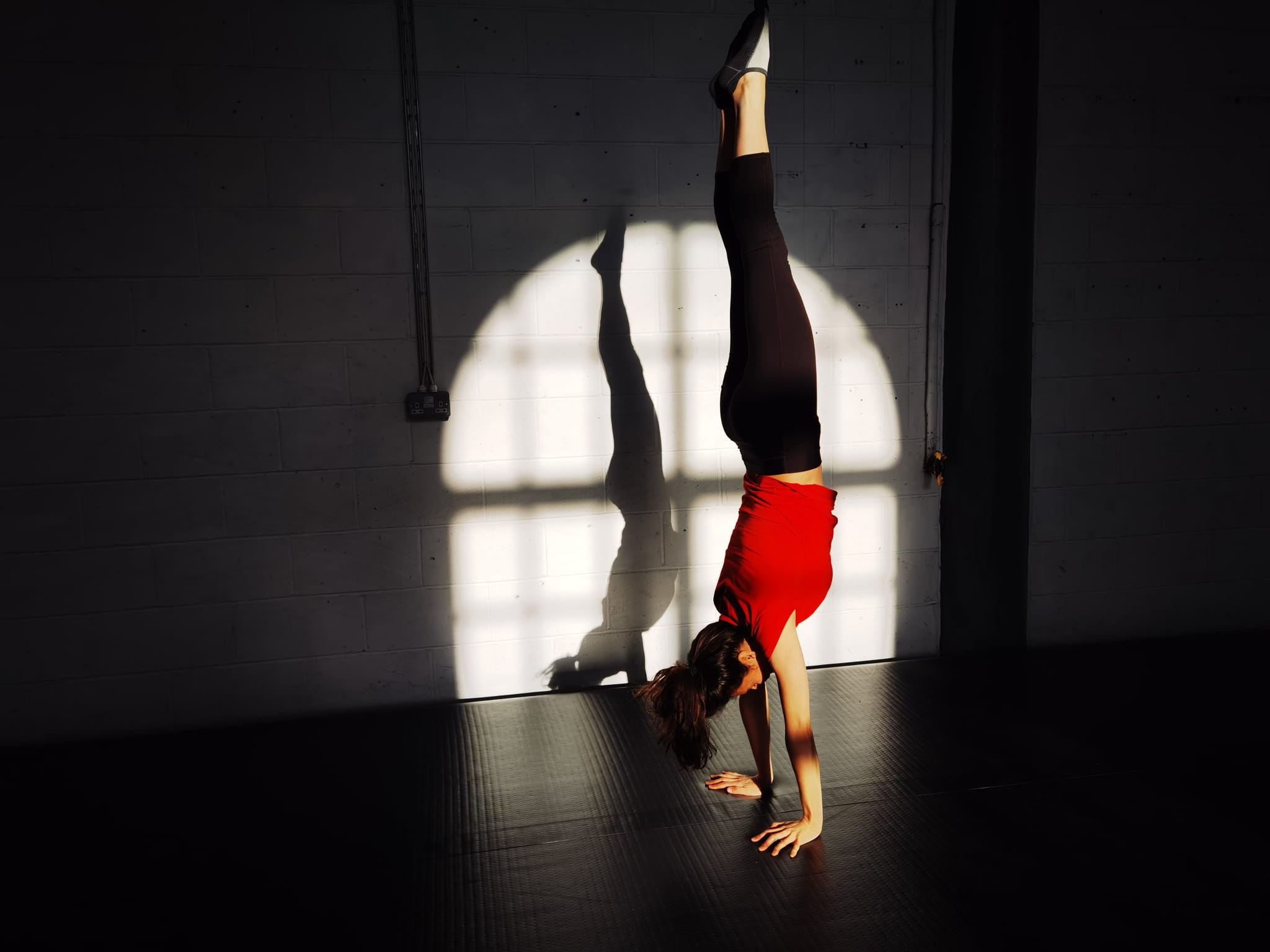
Movement and body work is where I find most joy, my medicine is to listen to my heart more—especially when the nudge seems silly or nonsensical. One of my shorter-term goals is to hold a 60s freestanding handstand by the end of the year. I can hold a handstand, but I want to build the strength and control to hold it for 60 seconds.
Here is what I know I need:
Structure: I’m following a specific program and have mapped out a week-by-week workout plan.
Support and accountability: in my case that looks like a gym membership, a private instagram account where I upload daily, with 2 of my closest and most trusted friends following my journey.
Self-love: continuing to build safety in my body so I keep choosing what’s best for me and remaining disciplined and consistent when things get tough.
Expanders: people who inspire me. On my private account I am very intentional about who I follow: people of all ages who are doing incredible things with their bodies and are pushing the limits of what we believe is possible later in life. Now the algorithm works in my favour, constantly showing me more of these gems. Their reality is slowly becoming my new normal.
This really is a return to something that's always brought me joy. Movement. My body doing something it wants to do, not something it has to do. And yes, it's also teaching me about following through, staying consistent, loving myself through the hard parts.
Will I magically become great at setting the best goals for myself and turn my life around in a year? Probably not. But I'm definitely more likely to succeed than I was 10 years ago. Besides, what I’ve learned is that we often overestimate what we can do in 6 months, and underestimate what we can achieve in 5 years.
Will the self-critical voice stop telling me I’m a washed-up failure? Probably not, but the more safety I find in my body, the more I am likely to stop listening to it and get on with my life.
As long as I’m alive, I can keep choosing differently. And right now, I’m choosing to show up for myself—one handstand at a time.
I’m one month in. Early days, but I’m still going.